 AVANYSYS
Consulting · Agentic Engineering
A spec-driven loop for building AI you can actually ship
Most AI projects fail quietly: the model works in the notebook, then drifts from what the business actually needed somewhere between training and production. The AI Development Life Cycle (ADLC) is how we close that gap — every phase reads from, and writes back to, one specification document, so nothing ships that the spec doesn’t account for.
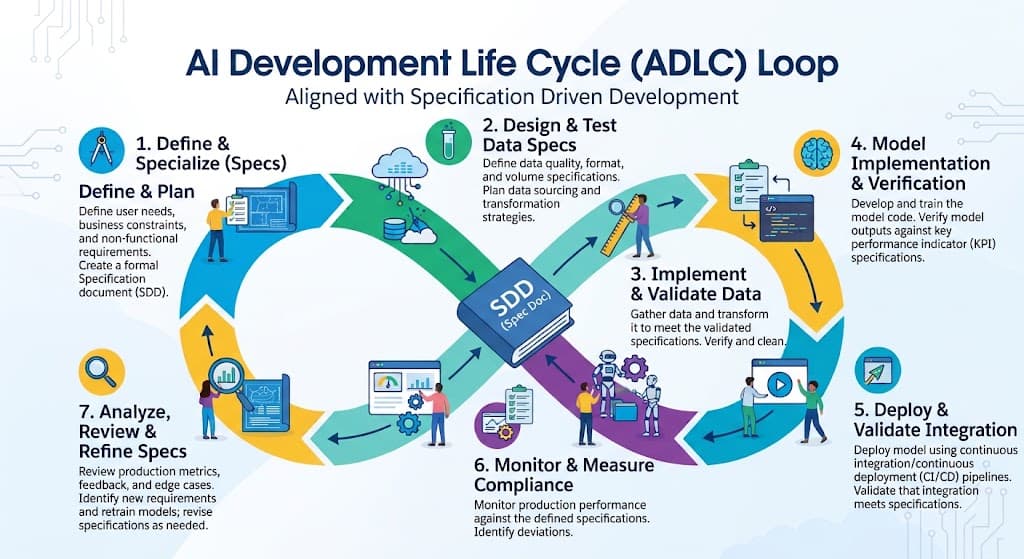
Here’s the discipline that makes the loop work: the Specification Document isn’t written up after the fact — it’s the one artifact every stage is built against and judged against. When we say a stage “passes,” we mean it matches the SDD, not that it looks right to us. That’s what lets seven separate stages, run by different people over months, still add up to one coherent system.
How we walk clients through it
The seven stages, in plain terms
Define & plan
We start by writing down what the system actually has to do, and what it must never do — user needs, business constraints, non-functional requirements like latency or compliance. That becomes a formal Specification Document, not a slide deck. If a requirement isn't in the SDD, it doesn't ship later, no matter how reasonable it sounds in a meeting.
Specify the data before touching it
Before a line of model code exists, we specify the data itself: quality thresholds, formats, expected volume, where it has to come from, and how it gets transformed. Most of the data problems we inherit from clients trace back to skipping this step and specifying the model before specifying the data.
Build the pipeline against the spec, not a hunch
We gather the data and transform it to meet the specs from stage two, then verify and clean it. Nothing moves to modeling until it passes validation against the document — a check against the spec, not a visual spot-check that happens to look fine.
Train the model, then hold it to the KPIs you set first
Only now do we develop and train the model. We verify its outputs against the key performance indicators defined back in stage one — not against whatever the model happens to produce. A model that performs well but misses the spec's KPIs isn't finished; it's a model that needs more work.
Ship it like software, then validate the integration too
We deploy through continuous integration and deployment pipelines, the same discipline as any other production software. Then we validate that the integration — not only the model — meets the original specification. In our experience, models fail in production from integration gaps as often as from model quality.
Measure against the spec, not a generic dashboard
Once live, we monitor production performance against the specifications we wrote, not against generic uptime or latency metrics borrowed from another project. The question in production is the same one we started with: is the system still doing what the SDD says it should?
Close the loop — and start it again
We review production metrics, real user feedback, and the edge cases nobody predicted, then feed what we learn back into the specification itself. New requirements get written down, models get retrained where needed, and the SDD gets revised. Then the loop runs again, from a better starting point.
Want this run on your own AI roadmap?
We’ll walk your team through the ADLC loop against a real project, not a hypothetical one.